Skip to content
UGC NET ও WB SET-এর ভর্তি চলছে
BAIOLearn Together
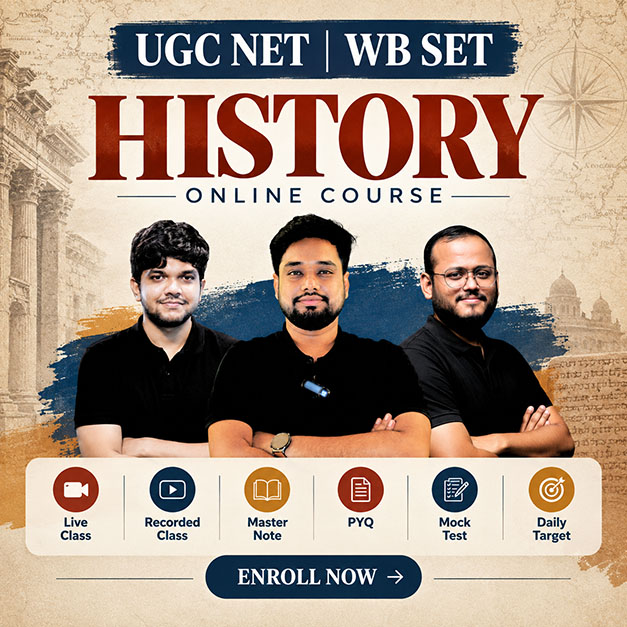
UGC NET History Course

BAIO — LEARN TOGETHER

UGC NET History Course

UGC NET History Online Course for UGC NET, JRF and WB SET preparation with recorded and live classes, focused study notes, PYQ practice, demo mock test and Daily Target resources.

Recorded ClassLive ClassMaster NotePYQ + Mock
COURSE FEE
₹14,999 ₹9,999

What You Get

Recorded Class

Topic-focused recorded learning for revision and flexible study.

Live Class

Selected live class resources for guided preparation.

Practice Resources

Master Notes, PYQ, Demo Mock Test and Daily Target.

LEARNING RESOURCES

HISTORY — Learning Dashboard

UGC NET History preparation resources in one place.

RECORDED CLASS 01

History Recorded Class 01

RECORDED CLASS 02

History Recorded Class 02

RECORDED CLASS 03

History Recorded Class 03

Our Teachers

Dr. Gourab Sarkar Sir

Dr. Gourab Sarkar Sir

Co-originator · History
NET, M.Phil, Ph.D. · 12 Year Teaching Experience
▶ View on YouTube
Atin Bhattacharjee Sir

Atin Bhattacharjee Sir

Teacher · History
M.A, UGC NET · 3 Year Teaching Experience
▶ View on YouTube
Akash Bhattacharjee Sir

Akash Bhattacharjee Sir

Teacher · History
NET, Ph.D. Scholar · 5 Year Teaching Experience
▶ View on YouTube

Pricing & Admission

MRP: ₹14,999

Full Payment: ₹9,999

Installment: ₹5,000 + ₹3,000 + ₹2,999 = ₹10,999

Unit 01 — Sources, Prehistory, Harappan and Early India +
  • Archaeological sources: exploration, excavation, epigraphy, numismatics; dating of archaeological sites
  • Literary sources: indigenous primary/secondary literature; dating problems; religious and secular literature; myths and legends; Greek, Chinese and Arabic accounts
  • Pastoralism and food production; Neolithic and Chalcolithic settlement, distribution, tools and exchange
  • Indus/Harappa Civilization: origin, extent, sites, settlement, craft specialization, religion, society, polity, decline, internal/external trade and first urbanization
  • Vedic and later Vedic periods; Aryan debates; political/social institutions; state structure; varnas and social stratification; religious/philosophical ideas; iron technology; South Indian megaliths
  • Mahajanapadas; monarchical and republican states; economic/social developments; second urbanization; Jainism, Buddhism and Ajivikas
Unit 02 — Mauryan, Post-Mauryan and Gupta Age +
  • Rise of Magadha; Alexander’s invasion and effects; Mauryan expansion, polity, society and economy
  • Ashoka’s Dhamma, decline and disintegration; Mauryan art and architecture; edicts, language and script
  • Indo-Greeks, Sungas, Satavahanas, Kushanas and Saka-Ksatrapas; Sangam literature, polity and society
  • Trade and commerce, Roman trade, Mahayana Buddhism, Kharavela and Jainism; Gandhara, Mathura and Amaravati schools
  • Gupta-Vakataka polity and society; agrarian economy; land grants, revenue, land rights and coins; temple architecture; Puranic Hinduism; Sanskrit literature
  • Science, technology, astronomy, mathematics and medicine; Harsha and his times; Salankayanas and Visnukundins
Unit 03 — Early Medieval Regional Kingdoms +
  • Deccan kingdoms: Gangas, Kadambas, Western/Eastern Chalukyas, Rashtrakutas, Kalyani Chalukyas, Kakatiyas, Hoysalas, Yadavas
  • South India: Pallavas, Ceras, Colas, Pandyas
  • Eastern India: Palas and Senas of Bengal, Varmans of Kamarupa, Bhaumakaras and Somavamsis of Odisha
  • Western India: Maitrakas of Vallabhi and Chalukyas of Gujarat; North India: Gurjara-Pratiharas, Kalacuri-Chedis, Gahadavalas and Paramaras
  • Administration, political structure and legitimation of kingship; agrarian economy, land grants, production relations, land rights, taxation, coins and currency
  • Trade, urbanization, ports, routes, guilds and Southeast Asian trade/colonization
  • Vaishnavism, Shaivism, temples, architecture, Dana, Tirtha and Bhakti; Tamil Bhakti movement; Shankara, Madhava and Ramanujacharya
  • Society, varna/jati/castes, women, gender, marriage, property, tribes, untouchability; education and institutions; regional languages
  • Feudal, segmentary and integrative models; Arab contacts; Suleiman; Ghaznavid conquests; Alberuni’s accounts
Unit 04 — Medieval Indian Political Developments +
  • Sources of medieval history: archaeological, epigraphic, numismatic, material, monuments, chronicles, Persian/Sanskrit/regional literature, daftar khannas, firmans, bahis/pothis/akhbarat and travellers’ accounts
  • Delhi Sultanate: Ghorids, Turks, Khaljis, Tughlaqs, Sayyids and Lodis; decline
  • Mughal Empire: Babur, Humayun, Suris; expansion and consolidation from Akbar to Aurangzeb; decline and later Mughals
  • Vijayanagara and Bahmanis; Deccan Sultanates—Bijapur, Golkonda, Bidar, Berar, Ahmadnagar; Eastern Gangas and Suryavamshi Gajapatis
  • Marathas: Shivaji and Swaraj; Peshwas; Mughal-Maratha relations; Maratha Confederacy and decline
Unit 05 — Administration and Economy +
  • Sultanate administration; nature of state; central, provincial and local administration; succession
  • Sher Shah’s reforms; Mughal central/provincial/local administration; Mansabdari and Jagirdari
  • Vijayanagara polity; Bahamani administration; Maratha Asta Pradhan
  • Frontier policies and inter-state relations under Sultanate and Mughals
  • Agricultural production and irrigation; village economy; peasantry; grants and loans; urbanization and demography
  • Industries: cotton textiles, handicrafts, agro-based industries, organization, factories and technology
  • Trade and commerce; European trade, trade centres and ports, transport and communication; hundi and insurance
  • State income/expenditure, currency and mint; famines and peasant revolts
Unit 06 — Society and Culture in Medieval India +
  • Social organization and social structure
  • Sufis: orders, beliefs, practices, leading saints and social synchronization
  • Bhakti movement: Shaivism, Vaishnavism and Shaktism; medieval saints and their socio-political/religious impact; women saints
  • Sikh movement: Guru Nanak, teachings, Adi Granth and Khalsa
  • Ruling class, religious groups, Ulemas, mercantile/professional classes and Rajput society
  • Rural society: petty chieftains, village officials, cultivators, non-cultivating classes and artisans
  • Women: Zanana and Devadasi systems
  • Education, centres, curriculum and Madarasa education
  • Painting schools—Mughal, Rajasthani, Pahari, Garhwali; music; Indo-Islamic and Mughal architecture; regional styles; gardens, forts, shrines and temples
Unit 07 — Sources and Rise of British Power +
  • Sources: archival materials, biographies, memoirs, newspapers, oral evidence, creative literature, painting, monuments and coins
  • European traders: Portuguese, Dutch, French and British
  • Establishment and expansion of British Dominion in India
  • British relations with Bengal, Oudh, Hyderabad, Mysore, Carnatic and Punjab
  • Revolt of 1857: causes, nature and impact
  • Company and Crown administration; central/provincial structures under East India Company
  • Paramountcy, civil service, judiciary, police and army; British policy in princely states
  • Local self-government; constitutional changes 1909–1935
Unit 08 — Colonial Economy and Indian Society in Transition +
  • Colonial economy: changing composition, volume and direction of trade
  • Commercialization of agriculture; land rights and settlements; rural indebtedness; landless labour; irrigation and canals
  • Decline of industries; artisans; de-urbanisation; economic drain; world wars and economy
  • British industrial policy; modern industries; factory legislation; labour and trade union movements
  • Monetary policy, banking, currency, exchange, railways, roads, communications, post and telegraph
  • New urban centres; town planning, architecture, urban society and problems
  • Famines, epidemics and government policy; tribal and peasant movements
  • Christian missions; critique of Indian social/economic practices and beliefs; education and activities
  • New education, English language, science, technology, public health and medicine; Indian Renaissance; socio-religious reform; middle class; caste associations
  • Women’s question, nationalist discourse, women’s organisations, legislation; printing press, journalism, public opinion; modernization of Indian languages and literary/performing arts
Unit 09 — National Movement and Post-Independence India +
  • Rise of Indian nationalism; social and economic basis
  • Indian National Congress 1885–1920; Early, Assertive Nationalists and Revolutionaries
  • Swadeshi and Swaraj; Gandhian mass movements; Subhas Chandra Bose and INA
  • Middle class and women in the national movement; Left Wing politics; Depressed Class movement
  • Communal politics; Muslim League and genesis of Pakistan; independence and partition
  • Post-independence challenges: partition, integration of princely states, Kashmir, Hyderabad and Junagarh
  • B.R. Ambedkar and making/features of the Constitution; bureaucracy
  • New Education Policy; economic policies and planning; development, displacement and tribal issues
  • Linguistic reorganization; Centre-State relations; Panchsheel; Emergency; LPG reforms
Unit 10 — Historical Method, Research Methodology and Historiography +
  • Scope and importance of History; objectivity and bias
  • Heuristics, criticism, synthesis and presentation; history and auxiliary sciences
  • History as science, art or social science; causation and imagination
  • Significance of regional history; recent trends of Indian history
  • Research methodology; hypothesis; area of proposed research; primary/secondary and original/transit sources; data collection
  • Trends in historical research; recent Indian historiography; selection of topic
  • Note-taking, references, footnotes and bibliography; thesis and assignment writing
  • Plagiarism, intellectual dishonesty and history writing
  • Greek, Roman and Church historiography; Renaissance and its impact
  • Positive/negative schools; Berlin Revolution and Von Ranke; Marxist philosophy; Spengler; Toynbee; Post-Modernism

Frequently Asked Questions

UGC NET History Course সম্পর্কে শিক্ষার্থীদের সাধারণ প্রশ্নগুলোর উত্তর।

History Course কেনার পর কীভাবে Access পাব?
Purchase সম্পন্ন হওয়ার পর পড়াশোনার মূল মাধ্যম হবে BAIO – Learn Together App। BAIO Team আপনার সঙ্গে যোগাযোগ করে App access এবং পুরো learning process বুঝিয়ে দেবে।
History Course-এ Live Class এবং Recorded Class কি থাকবে?
হ্যাঁ। Enrolled students-এর জন্য Live Class এবং Recorded Class সহ course-এর নির্ধারিত learning resources-এর access থাকবে।
History Course-এ কয়টি Master Note থাকবে?
History Course-এর Learning Dashboard-এ একটি Master Note থাকবে। এটি History-এর verified Master Note resource।
History-এর PYQ কি কোর্সের সঙ্গে পাওয়া যাবে?
হ্যাঁ। UGC NET History preparation-এর জন্য Topic-wise PYQ resource enrolled students access করতে পারবেন।
History Mock Test কি থাকবে?
হ্যাঁ। History preparation-এর জন্য Mock Test resource থাকবে।
Daily Target কি History Course-এ থাকবে?
হ্যাঁ। Daily Target resource-এর মাধ্যমে preparation-কে নিয়মিত ও structuredভাবে এগিয়ে নেওয়া যাবে।
History Course-এ Doubt Support কীভাবে পাওয়া যাবে?
WhatsApp Group, Telegram, Live Doubt Class এবং Teacher Contact— সব ধরনের support facility থাকবে।
History Course-এ কি History-এর relevant teachers-ই থাকবেন?
হ্যাঁ। History Course Page-এ Dr. Gourab Sarkar Sir-এর সঙ্গে History-এর relevant teachers-ই থাকবে।
Purchase করার পরে Refund করা যাবে কি?
Purchase করার পর নির্ধারিত প্রাথমিক সময়ের মধ্যে refund request করা যাবে। Refund processing BAIO Team-এর মাধ্যমে করা হবে।