Skip to content
UGC NET ও WB SET-এর ভর্তি চলছে
BAIOLearn Together
UGC NET Education Course

BAIO — LEARN TOGETHER

UGC NET Education Course

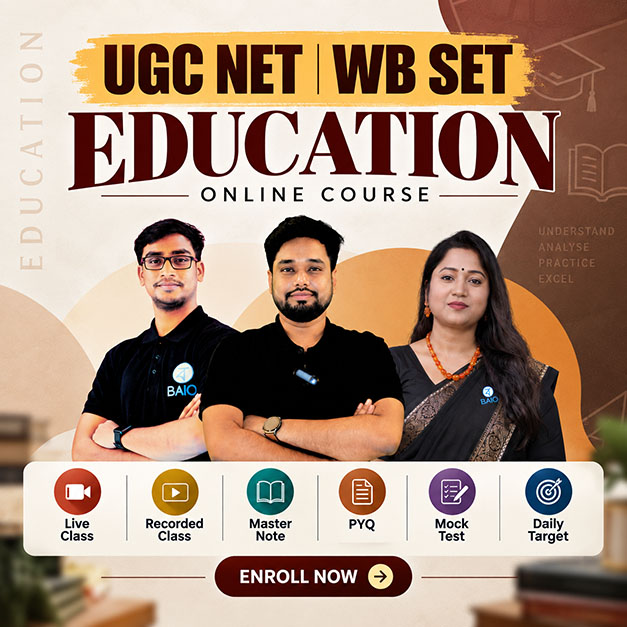
UGC NET Education Online Course for UGC NET, JRF and WB SET preparation with recorded and live classes, subject-focused Master Notes, PYQ practice, demo mock test and Daily Target resources.

Recorded ClassLive ClassMaster NotePYQ + Mock
COURSE FEE
₹14,999 ₹9,999

What You Get

Recorded Class

Topic-focused recorded learning for revision and flexible study.

Live Class

Selected live class resources for guided preparation.

Practice Resources

Master Notes, PYQ, Demo Mock Test and Daily Target.

LEARNING RESOURCES

EDUCATION — Learning Dashboard

UGC NET Education preparation resources in one place.

RECORDED CLASS 01

Education Recorded Class 01

RECORDED CLASS 02

Education Recorded Class 02

RECORDED CLASS 03

Education Recorded Class 03

Our Teachers

Dr. Gourab Sarkar Sir

Dr. Gourab Sarkar Sir

Co-originator · Education
NET, M.Phil, Ph.D. · 12 Year Teaching Experience
▶ View on YouTube
Tapash Jana Sir

Tapash Jana Sir

Teacher · Education
NET-JRF, Ph.D. Scholar · 5 Years Teaching Experience
▶ View on YouTube
Dr. Rima Dutta Ma’am

Dr. Rima Dutta Ma’am

Teacher · Education
NET, Ph.D. · 11 Year Teaching Experience
▶ View on YouTube

Pricing & Admission

MRP: ₹14,999

Full Payment: ₹9,999

Installment: ₹5,000 + ₹3,000 + ₹2,999 = ₹10,999

SYLLABUS COVERAGE

UGC NET Education Syllabus — 10 Units & Topics

এই ব্লকে Education-এর UGC NET syllabus-এর ১০টি Unit এবং প্রতিটি Unit-এর অন্তর্গত সব topics রাখা হয়েছে। এই কোর্স পুরো সিলেবাসকে কভার করছে।

Unit 01 — Educational Studies +
  • Indian schools of philosophy: Sankhya, Yoga, Vedanta, Buddhism, Jainism; Vidya/Dayanand Darshan; Islamic traditions; educational aims, methods and valid knowledge
  • Western schools: Idealism, Realism, Naturalism, Pragmatism, Marxism, Existentialism; information, knowledge and wisdom
  • Sociology of Education: Symbolic Interaction, Structural Functionalism, Conflict Theory; social institutions—family, school and society
  • Social movements and theories: Relative Deprivation, Resource Mobilization, Political Process Theory, New Social Movement Theory
  • Socialization and education; education and culture; contributions of Swami Vivekananda, Rabindranath Tagore, Mahatma Gandhi, Aurobindo, J. Krishnamurthy, Paulo Freire, Wollstonecraft, Nel Noddings and Savitribai Phule
  • National values in the Indian Constitution—socialism, secularism, justice, liberty, democracy, equality, freedom with special reference to education
Unit 02 — History, Politics and Economics of Education +
  • Committees and Commissions: Secondary Education Commission 1953; Kothari Commission 1964–66; NPE 1986/1992; National Commission on Teachers 1999; NCF 2005; National Knowledge Commission 2007; Yashpal Committee 2009; NCFTE 2009; Justice Verma Committee 2012
  • Educational policy and national development; determinants and policy formulation process
  • Economics of Education: cost-benefit vs cost-effective analysis; returns to higher education; Signaling Theory vs Human Capital Theory; educational finance and budgeting
  • Politics and Education: liberal, conservative and critical perspectives; Behaviouralism, Systems Analysis, Rational Choice; political development and political socialization
Unit 03 — Learner and Learning Process +
  • Growth and development; cognitive processes and stages; personality theories—Freud, Carl Rogers, Gordon Allport, Max Wertheimer, Kurt Koffka; mental health and mental hygiene
  • Intelligence: unitary to multiple; social, multiple and emotional intelligence; Sternberg and Gardner; assessment of intelligence; problem solving, critical thinking, metacognition and creativity
  • Learning theories: behaviouristic, cognitive and social; social learning, social competence, social cognition, social relationships and socialization goals
  • Guidance and Counselling: nature, principles, need; educational, vocational, personal, health and social guidance; directive, non-directive and eclectic approaches; REBT and humanistic/person-centred counselling; behaviouristic, rational, emotive and reality theories
Unit 04 — Teacher Education +
  • Meaning, nature and scope; types of teacher education programmes; curriculum structure and vision in NCERT/NCTE documents; pre-service transactional approaches—expository, collaborative, experiential
  • Knowledge base from Schulman, Deng, Luke & Habermas; reflective teaching and strategies; behaviouristic, competency-based and inquiry-oriented models
  • In-service teacher education: concept, need, purpose, scope; organization and modes; SSA, RMSA, SCERT, NCERT, NCTE and UGC; planning considerations
  • Profession and professionalism; teaching as a profession; professional ethics; teacher development; ICT integration; quality enhancement and innovation
Unit 05 — Curriculum Studies +
  • Concept and principles of curriculum; curriculum development strategies and stages; philosophical, sociological and psychological foundations; benchmarking; role of UGC, NCTE and universities
  • Curriculum design models: academic/discipline based, competency based, social functions/activities, individual needs & interests, outcome based integrative, intervention and CIPP
  • Instructional system, media, techniques and materials; curriculum and instruction approaches; Tyler, Stake, Scriven and Kirkpatrick evaluation models
  • Curriculum change: meaning, types, factors, approaches; roles of students, teachers and administrators; curriculum research and research types
Unit 06 — Research in Education +
  • Meaning and scope of educational research; scientific method, characteristics and types; aims; fundamental, applied and action research; quantitative and qualitative approaches; descriptive, experimental and historical designs
  • Variables, concepts and constructs; independent, dependent, extraneous, intervening and moderator variables; hypotheses; research proposal; universe and sample; probability and non-probability sampling
  • Research tools: validity, reliability, standardisation; rating scale, attitude scale, questionnaire, aptitude and achievement tests, inventory; observation, interview and projective techniques
  • Measurement scales; quantitative data analysis; hypothesis testing; Type I/II errors; significance, power and effect size; parametric/non-parametric techniques; correlation, t-test, z-test, ANOVA, chi-square; qualitative analysis and triangulation
  • Qualitative designs: Grounded Theory, Narrative Research, Case Study, Ethnography and Mixed Method Designs
Unit 07 — Pedagogy, Andragogy and Assessment +
  • Pedagogy and pedagogical analysis; critical pedagogy; Memory Level—Herbartian, Understanding Level—Morrison, Reflective Level—Bigge and Hunt
  • Andragogy: meaning, principles, self-directed learning competencies, Malcolm Knowles and Dynamic Model of Learner Autonomy
  • Assessment: meaning, nature, perspectives; placement, formative, diagnostic and summative; objectives and outcomes; cognitive, affective and psychomotor domains
  • Feedback devices; guidance as feedback; portfolios, reflective journal, field engagement with rubrics, competency-based evaluation and ICT resources
  • Flanders and Galloway interaction analysis; teacher evaluation criteria; self and peer evaluation rubrics
Unit 08 — Technology in/ for Education +
  • Educational Technology as a discipline: IT, CT, ICT and instructional technology; applications in formal, non-formal, informal and inclusive education
  • Behaviourist, cognitive and constructivist theories and instructional design; Skinner, Piaget, Ausubel, Bruner, Vygotsky
  • Systems approach; ADDIE, ASSURE, Dick and Carey, Mason’s; Gagne’s Nine Events; Five E’s; constructivist instructional design
  • Computers in education: CAI, CAL, CBT, CML; ODLM; e-learning approaches—offline, online, synchronous, asynchronous, blended, mobile
  • Emerging e-learning trends: social learning, Web 2.0, social networking, blogs, chats, video conferencing, forums, OER, MOOCs, e-inclusion, assistive technology, quality and D&M IS Success Model
  • ICT in evaluation, administration and research; e-portfolios, repositories, libraries, online/offline assessment tools and test generators
Unit 09 — Educational Management, Administration and Leadership +
  • Educational management and administration: meaning, principles, functions, institutional building, POSDCORB, CPM, PERT, systems, SWOT, Taylorism, bureaucracy, human relations, compliance, development and climate
  • Leadership: trait, transformational, transactional, value-based, cultural, psychodynamic and charismatic approaches; Blake & Mouton, Fiedler, Tri-dimensional, Hersey & Blanchard and LMX models
  • Quality in education: Indian and international perspectives; inspection, quality control, quality assurance, TQM, Six Sigma; Shewhart, Deming and C.K. Prahalad
  • Change management: planned change, three-step model, Japanese models, Just-in-Time, Poka-yoke, cost of quality, cost-benefit and cost-effective analysis; NAAC, QCI and INQAAHE
Unit 10 — Inclusive Education +
  • Inclusive Education: concept, principles, scope and target groups; marginalized groups and learners with disabilities; special, integrated and inclusive education
  • Legal provisions and policies: NPE 1986, Programme of Action 1992, PWD Act 1995, National Policy on Disabilities 2006, NCF 2005, RCI Act 1992, SSA and UNCRPD
  • Impairment, disability and handicap; ICF model; school readiness and models of inclusion; diverse learners, disabilities, causes and prevention; identification and educational evaluation
  • Inclusive classroom planning and management; infrastructure, human resources, instructional practices, curriculum adaptations; assistive/adaptive technology; IEP and remedial teaching
  • Parent-professional partnership; role of parents, peers, professionals, teachers and school; barriers and facilitators; current status, ethical issues and research trends in India

Frequently Asked Questions

UGC NET Education Course সম্পর্কে শিক্ষার্থীদের সাধারণ প্রশ্নগুলোর উত্তর।

Education Course কেনার পর কীভাবে Access পাব?
Purchase সম্পন্ন হওয়ার পর পড়াশোনার মূল মাধ্যম হবে BAIO – Learn Together App। BAIO Team আপনার সঙ্গে যোগাযোগ করে App access এবং learning process বুঝিয়ে দেবে।
Education Course-এ Recorded এবং Live Class দুটোই থাকবে?
হ্যাঁ। Enrolled students-এর জন্য Recorded Class ও Live Class-এর access থাকবে।
Education-এর Master Note কি পাওয়া যাবে?
হ্যাঁ। Education-এর নির্ধারিত Master Note resources enrolled students access করতে পারবেন।
Education-এর PYQ এবং Mock Test কি থাকবে?
হ্যাঁ। PYQ এবং Mock Test resources course access-এর সঙ্গে available থাকবে।
Daily Target কি Education preparation-এর জন্য থাকবে?
হ্যাঁ। Daily Target resource-এর মাধ্যমে preparation-কে structuredভাবে এগিয়ে নেওয়া যাবে।
Education Course-এ Doubt Support কীভাবে পাওয়া যাবে?
WhatsApp Group, Telegram, Live Doubt Class এবং Teacher Contact— সবকটি support facility থাকবে।
শুধু Education-এর শিক্ষক ও relevant resources-ই কি থাকবে?
হ্যাঁ। Education Course Page-এ Education-এর subject-specific teachers এবং Education-এর verified learning resources-ই দেখানো হবে।
Purchase করার পরে Refund-এর সুযোগ আছে কি?
Purchase করার পর নির্ধারিত প্রাথমিক সময়ের মধ্যে refund request করা যাবে। Refund processing BAIO Team-এর মাধ্যমে সম্পন্ন হবে।